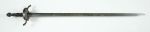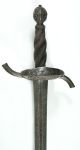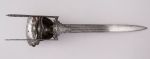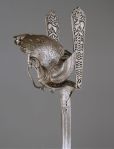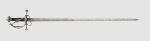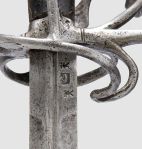
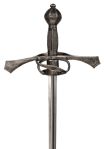
Estoc of the Trebanten Guard of the Prince Electors of Saxony
- Dated: 1580
- Culture: German
- Medium: steel, iron, fish-skin
- Measurements: overall length 127 cm (50 inches)
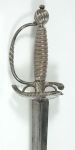
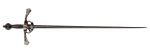
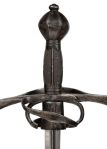
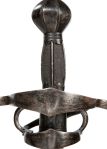
The iron hilt is formed of flattened bars comprising of a pair of long quillons drooping slightly towards fish-tail terminals. The large D-shaped ring-guard is placed between and has a smaller version below, carried by a pair of arms, each ring widening towards the middle.
The inner guard is formed from a single diagonal bar, linking the head of the forward arm to the base of the rear quillon, the base of the hilt with an oval decorated tubular sleeve to fit over the mouth of the scabbard. The octagonal pommel swells about the middle and it’s cut with a pairs of narrow segmental flutes and rising to an octagonal bun-shaped button.
The grip is reinforced by moulded slender bars set between a pair of cusped and linear engraved collars and retaining its original fish-skin cover. The mounted contingent of the Saxon Trebanten guard was formed of a company of one hundred men on black horses.
Their uniform included a blackened comb morion with etched and gilt ornament, black doublets and yellow hose and stockings, the colours being those of the Arms of the Electors of Saxony.
Source: Copyright © 2016 Curator’s Eyes

Tag: photo set
Simone Biles isn’t just incredible, she’s a scientific phenomenon
Simone Biles is officially a superstar and a scientific marvel.When Biles pulls off her signature move, her distance from the floor is basically equal to her height. She gets that high up on the strength of her muscles, propelling herself with enough speed and kinetic energy to actually reach that height. And the way she lands literally seems to defy physics.
Follow @the-future-now
#I knew it! #I knew she was being rude to science
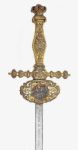
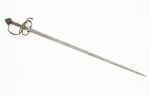
Court Sword
- Dated: third quarter of the 19th century
- Culture: Spanish
The cast grip features a crown pommel, while guard shows the badge of the Equestrian Order of the Holy Sepulcher of Jerusalem enameled in orange. The sword has a straight, double-edged blade struck, “FABRICA DE TOLEDO 1868” at the forte.
Sidenotes:
- The Equestrian Order of the Holy Sepulchre of Jerusalem (Latin: Ordo Equestris Sancti Sepulcri Hierosolymitani, OESSH) is a Roman Catholic order of knighthood under the protection of the pope. It traces its roots to Duke Godfrey of Bouillon, principal leader of the First Crusade.
- In 1496, Pope Alexander VI created the office of Grand Master of the Order, and the office vested in the papacy.
- The office of Grand Master remained vested in the papacy until 1949.
- Since then a cardinal has been grand master.
- The Pope is sovereign of the Order, and it enjoys the protection of the Holy See and has its legal seat at Vatican City.
- Five major orders were formed in the Holy Land between the late 11th century and the early 12th century: the Knights of the Holy Sepulchre (circa 1099), Knights Templar (circa 1118), Knights Hospitaller (circa 1099) (St John), Knights of the Hospital of St Mary of Jerusalem (Teutonic Knights) and Knights of St Lazarus.
Source: Copyright © 2016 Auction Flex
We’re excited to announce Stephane Chatton as Head of the new IKMF Disabled Krav Maga devision. IKMF is holding an open vote about the title; ‘Adaptive Krav’ or ‘HandiKrav’. Please share your thoughts with us.
I am so stoked about this program. I really want to get better so that I can teach this!
Broadsword
- Medium: steel, leather
Source: Copyright © 2016 The Fitzwilliam Museum, University of Cambridge, UK
Katar Dagger
- Dated: 17th century
- Geography: Thanjavur, Tamil Nadu
- Culture: Indian, Thanjavur; blade, European
- Medium: steel
- Measurements: L. 21 ¾ in. (55.2 cm); W. 5 in. (12.7 cm); Wt. 2 lbs. 3 oz. (992.2 g)
- Provenance: [William Ockelford Oldman, London, before 1935; sold to Stone]; George Cameron Stone, New York (by 1934–d. November 18, 1935; his bequest to MMA
Sword
- Dated: 17th century
- Culture: European
Source: Copyright © 2015 Musée de l’Armée, Dist. RMN-Grand Palais/Photo: Emilie Cambier
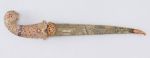
Khanjar Dagger with Sheath
- Dated: 18th century
- Culture: Indian, Mughal
- Medium: Steel, rock crystal, gold, silver, rubies, diamonds, emeralds, textile, wood
- Measurements: L. 15 ¾ in. (40.01 cm)
Cut and thrust Sword
- Dated: circa 1560
- Culture: German
- Measurements: overall length 102 cm
The sword features a straight blade with a short groove on both sides, and with three smith marks on both the obverse and reverse sides of the ricasso, an iron knuckle bow hilt, cut pommel and a leather-covered grip.
Small Sword
- Dated: circa 1760
- Production: England (hilt); France (blade)
- Medium: steel, leather, silver
- Provenance: Mr James Stewart Henderson of ‘Abbotsford’, Downs Road, St Helen’s Park, Hastings, Sussex
Small sword with a colichemarde type blade. The scabbard is covered with leather, and has silver mounts. The top suspension loop is engraved ‘Feesey pallmell’.
Source: Copyright © 2015 The Fitzwilliam Museum, University of Cambridge, UK