i just remembered this story my dad told me one time, about abraham lincoln
a guy challenged abe to a duel once. lincoln very much did not want to duel this cat.
so lincoln agreed, on the condition he got to choose the weapon. maybe that was how it generally went in 19th century dueling culture, i have no idea.
the guy said “sure”
lincoln said, “ok. broadswords.”
so that poor would-be opponent shows up on the day of the would-be duel, and abe is outside, doing, like, some quick sword warmups.
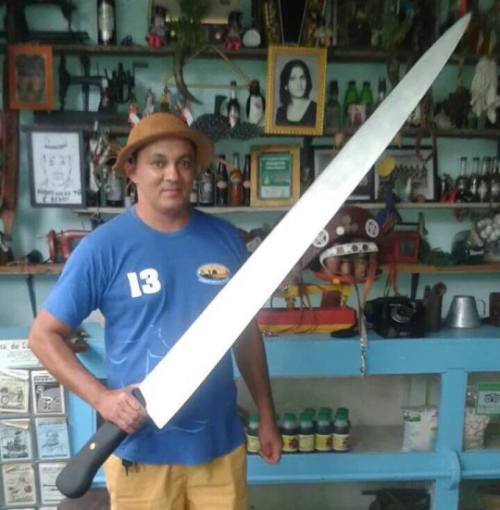
now, back in lincoln’s day, he was, as any american schoolchild can tell you, the tallest fucking dude on the entire fucking planet, so please try to even imagine the majestic reach of this stovepiped giant’s condor-like wingspan.
(wingspan plus broadsword.)
abe’s enemy takes one look at this, does some quick mental calculations on his own arm length (mortal, human), turns around and goes home.
the best part is that, as i remember it, lincoln of course had no fucking idea how to swordfight. it was the 1800s. we had guns. he’d just been, like, waving this giant sword around haphazardly, whacking at tree limbs, making his arms look as big as possible because he knew this joker could see him, and he knew that guy didn’t know that lincoln didn’t know what the hell to do with a broadsword.
anyway, i don’t actually know if that story is true or not but i really really hope it is. i would love to know that the president who defeated the confederacy was also fucking hilarious.
A medieval surgeon repaired this broken bone with riveted copper plate. "An unknown man got his axe arm badly injured in a battle. His humerus was found at excavations of Varnhem monastery in 1928, and is the only one of its kind in Sweden. Interventions in the upper arm are difficult to do even for today’s experts. It’s easy for nerves and blood vessels to be damaged. Yet a medieval “surgeon” has managed to cover the injury to the man’s arm bone, and also pin it with rivets; you can see three of them in the plate. We can also see that the man survived: new bone has been formed after the procedure.“ From here
A remarkably gilt Smallsword belonging to Franz I, attributed to Franz Mazenkopf, Austria, Salzburg, ca. 1740-1745, housed at the Kunsthistorisches Museum.
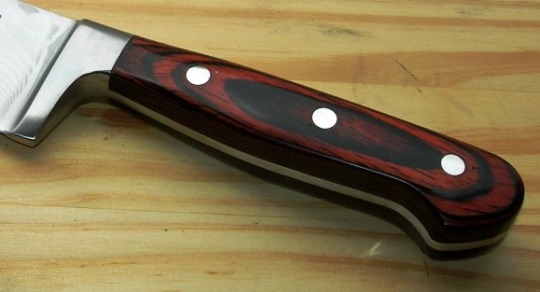
I don’t wanna like Kill The Joke but this brings up a really cool fact about swords in ~14th-16th century Germany! The only people who were allowed to own Real Swords were the royalty and nobility BUT! Everyone else was allowed to own knives. The definition of a knife, however, was based on not length but handle construction, and to some extent how it was sharpened. The handle had to be constructed Like So with 2 pieces of wood sandwiching the metal tang.
Only one edge was allowed to be sharpened, but oftentimes a small part (a couple inches) of the short edge (e.g. the edge that wasn’t sharp) would be sharpened, and weapon design often allowed for this
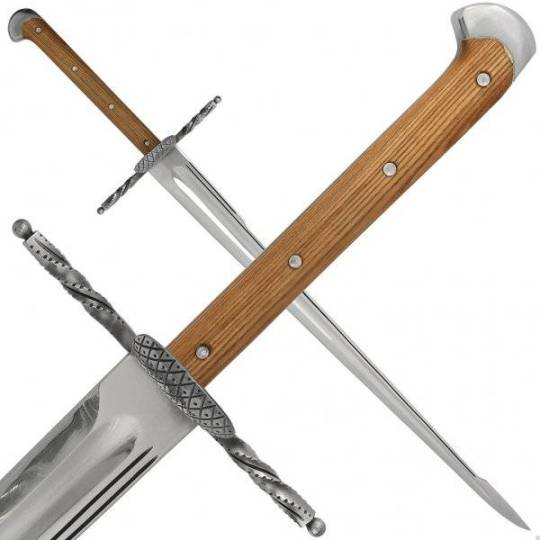
In this way, something that looked like This, a messer of just over a meter in length…
…would be legally considered a knife, and therefore allowable for non-nobility to possess. (you can also see the bit on the back of the tip that would be sharpened)
So @swordmutual, there’s a not definitive but certainly interesting historical perspective on your question
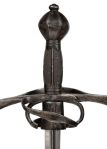
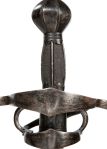
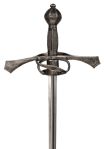
Estoc of the Trebanten Guard of the Prince Electors of Saxony
Dated: 1580
Culture: German
Medium: steel, iron, fish-skin
Measurements: overall length 127 cm (50 inches)
The iron hilt is formed of flattened bars comprising of a pair of long quillons drooping slightly towards fish-tail terminals. The large D-shaped ring-guard is placed between and has a smaller version below, carried by a pair of arms, each ring widening towards the middle.
The inner guard is formed from a single diagonal bar, linking the head of the forward arm to the base of the rear quillon, the base of the hilt with an oval decorated tubular sleeve to fit over the mouth of the scabbard. The octagonal pommel swells about the middle and it’s cut with a pairs of narrow segmental flutes and rising to an octagonal bun-shaped button.
The grip is reinforced by moulded slender bars set between a pair of cusped and linear engraved collars and retaining its original fish-skin cover. The mounted contingent of the Saxon Trebanten guard was formed of a company of one hundred men on black horses.
Their uniform included a blackened comb morion with etched and gilt ornament, black doublets and yellow hose and stockings, the colours being those of the Arms of the Electors of Saxony.









 Marie's Fitness Blog